Georges St. Pierre, better known to fight fans worldwide as “GSP,” is currently the
UFC Welterweight Champion.
His publicly stated goal is to retire as the best pound-for-pound
fighter in the world and, at a record of 23-2, ESPN currently ranks him
as the #3 pound-for-pound fighter in the world. I think he’ll get
there.
His intellect–and consistency–is what separates him from the brawlers. He has a scientific approach to winning.
This isn’t limited to training. He considers nutrition a critical
part of his fight prep, just as important as being in the cage. In this
respect, 2009 marked an inflection point. That year, after successfully
defending his Welterweight title in his second fight against
BJ Penn, GSP hired
Dr. John Berardi of
Precision Nutrition to help him gain lean muscle tissue and improve his
recovery abilities. Berardi, in charge of the nutrient science,
recommended that GSP hire Jennifer Nickel and Rosario “Ross” Gurreri,
two chefs in the Montreal area who worked at
Cavalli and
Bice restaurants, for his meal preparation.
In the next 8 weeks,
GSP gained approximately 12 pounds of lean muscle and
bulked up to 195 pounds. His upgraded speed and power helped him to
dominate every subsequent opponent, posting a 5-0 record since 2009.
This post will walk you through how GSP ate during his 2009 transformation…
While he no longer has a private chef for everyday meals, GSP still
consults with Berardi and still flies Jen and Ross to his hotel the week
before a big fight to cook for him and his entourage.
First, we’ll look at GSP’s meal plan.
Second, we’ll look at how your design your own version using Dr. Berardi’s guidelines.
What Does GSP Eat?
Below is the 2009 meal plan designed for GSP by Dr. Berardi.
It’s based it around “anytime” (AT) and “post-workout” (PW) meals.
He gave the guidelines to Jen and Ross and they prepared a menu of
roughly 30-40 items that adhered to the calorie and macro-nutrient
(carbohydrate, protein, and fat) requirements and ratios. Berardi
explains the basic approach:
“Georges’ baseline menu is about 3200-3500kcal per day, with around
250 grams of protein, 350 grams of carbs, and 100 grams of fat. PW meals
are higher in protein and carbs, while being lower in fat, and eaten
right after workouts. AT meals are higher in protein and fat, while
being low in carbs.”
The brands and products mentioned are those Berardi recommended for GSP. Though Berardi formulated the original
Surge Recovery product while
wrapping up his PhD studies in Exercise and Nutritional Biochemistry at
the University of Western Ontario and Yale University, he has no
financial interest in the products.
Editorial note: In the descriptions, I use both “GSP” and “you”
interchangeably, assuming that you might want to duplicate this for
yourself.
3 Meals Provided by Ross and Jennifer
- 1 lower carb anytime meal to be eaten whenever you like: 650 calories – 60g protein, 40g carbs, 30g fat
- 1 lower carb anytime meal to be eaten whenever you like: 650 calories – 60g protein, 40g carbs, 30g fat
- 1 high-carb post-exercise meal to be
eaten immediately after training (a recipe that can be eaten cold): 700
calories – 60g protein, 100g carbs, 10g fat
You’ll find two sample recipes
at the end of this post.

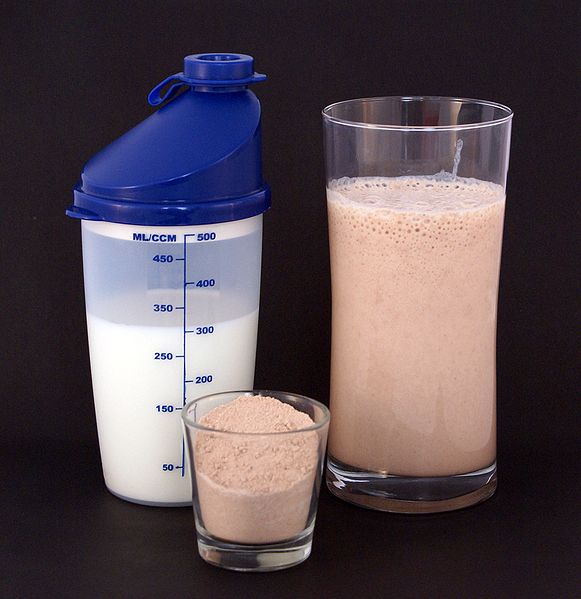
Credit: Wikimedia Commons
2 Daily Super Shakes
GSP made sure to drink shakes every day, to get sufficient protein between meals. Here is his plan:
1 super shake at a time, between meals, mixed with almond milk or water. This was used to wash down 4 fish oil capsules
- 1 scoop milk-based protein powder
- 1 scoop greens supplement
- 1 cup frozen mixed berries (use “mixed”
to avoid developing food intolerances from eating too much of a single
variety) 282 calories – 18g protein, 25g carbs, 12g fat
Berardi’s suggested products: Muscle Milk protein powder from
CytoSport, greens+ from
Genuine Health, Flameout fish oil capsules from
Biotest.
Workout Nutrition
GSP added protein bars in addition to his two daily shakes. Here is his daily feeding schedule.
Before training: ½ protein bar . Recommended Brand:
Finibar from Biotest: 125 calories – 7g protein, 20g carbs, 4g fat
During training: 1 workout drink. Recommended brand:
Surge Workout Fuel from Biotest: 85 calories – 8g protein, 21g carbs, 0 fat
Immediately after training: 1 workout drink. Recommended Brand:
Surge Recovery from Biotest: 330 calories – 25g protein, 44g carbs, 1g fat. Followed by a post-workout meal 1 hour later.
Optional: 1 Additional Meal
If you’re hungry, eat 1 additional meal per day. It can be whatever
you like, as long as it’s lower in carbs and higher in protein and fat.
Given GSP’s leanness, he was given more latitude, as Berardi explains:
“The rule was to eat everything on the menu and then, if he wanted
anything else, he could have it. Some days that meant Subway, other
days McDonald’s. It didn’t matter. As long as he got his required food
in each day, he could eat whatever discretionary calories he wanted. He
ended up reporting that he had a few extra meals a week. But he was
pretty satisfied from his normal menu, so he didn’t need to use too many
discretionary calories.”
Approximate Total Baseline Intake: 3104 calories – 256g protein (30%), 315 carbs (40%), 99g fat (30%)
Q&A With Dr. Berardi–How to Mimic GSP’s Results
What guidelines should someone use if trying to replicate the above?
“When determining a client’s macronutrient split, at Precision
Nutrition we use body-type specific guidelines. In essence, we plan
someone’s nutrition according to their somatotype, as follows:
Ectomorphs — around 25% p (protein), 55%c (carbs), 20%f (fat)
Mesomorphs — around 30%p, 40%c, 30%f
Endomorphs — around 35%p, 25%c, 40%f”
Definitions:
Ectomorph – Thin build, challenging to put on weight (muscle or fat); Example: long-distance runner.
Mesomorph – Muscular build, can lose or gain muscle easily (fat gain minimal); Example: sprinter or gymnast.
Endomorph – Large build, easy to put on weight (both good and bad); Example: shotputter or football lineman.
“Since GSP is a clear mesomorph, that’s why his split looked like it
did. As far as calories, for most people wanting to gain weight, we’d
multiply body weight in pounds x 20-22 to determine the total. This
would have put GSP at 3400 to 3700kcal to start with. However, he was
chronically underfed leading up to us working together, so jumping all
the way up to 20 or 22 would have probably led to fat gain. So we chose
a multiplier of 18 to start with. This ended up being perfect for him,
based on the outcomes described above.”
How much did GSP weigh when consuming the above?
“We started this plan about 2 months before a training camp when he
weighed around 183 lbs. In the 2 months leading up to camp, the plan
took him to about 195 lbs. At that point his weight stabilized, which
was perfect going into camp. We didn’t want him much heavier because it
then might be too hard to cut to 170.
In the next 3 months, the diet stayed the same, but the high volume
of camp helped him come down to about 188 the week before the fight.
That made the cut to 170 pretty easy. We did the cut from 188 to 170 in
5 days (from M-F). Then in 24 hours (from F-Sa), he rehydrated to
about 188 lbs for the fight.”
How is the Food Prepared?
In 2009, when the GSP experiment began, Jen had the entire
professional kitchen of Bice to herself in the morning and prepared 3
meals for Georges during that time: a post-workout meal (that could be
eaten cold, so he could have it directly after his workout), a dinner
meal, and a breakfast meal for the next morning. Meal prep took between
2-4 hours.
Jen shopped for 100% organic foods, cooked the meals, and had someone
else deliver the meals to Georges’ gym once a day. Georges, having
eaten breakfast and workout shakes, would eat the post-workout meal
directly after training in the early afternoon. These below answers and
suggestions are from Jennifer, who has been a chef for 12 years and now
runs a private catering business in Toronto.
Equipment and Methods
First, Jen has the right gear for the job. In Jen’s tool kit are:
- Microplane zester/grater
- 7-9” chefs knives (MAC MTH-80 8″ Chef’s Knife, which “stays sharp longer than any knife I have ever used”)
- Peugeot peppermill
-
Kuhn Rikon vegetable peelers
For cooking methods, Jen explains the basics: “It’s important to have access to a stove-top grill (she uses a
Le Creuset cast-iron “griddle”)
and a bamboo steamer. Having this equipment makes it easy to cook fast
meals because they are stationary and easy to clean, so you don’t have
to mess around with pots and pans.” These cooking vessels stay on the
stovetop and are quickly cleaned on the stovetop so there’s no sink
involved.
“For example, if I were making grilled tuna with Asian greens and
sweet potato, I would station a steamer and a cast-iron grill on the
back burners of my stove, steam the potato first and then use the same
steamer to cook the greens. Using equipment like this guarantees that
you won’t be slopping extra cooking fat in your frying pan or killing
your green vegetables in boiling water. It’s fast and easy.”
Shopping Tips
“In terms of buying fruit, always buy what appears to be heavy for
it’s size. And for vegetables, look for bright colors and perky
leaves. Fish should have glossy flesh, bright eyes and have the slight
aroma of sea water. Meat should be freshly butchered whenever possible
and should be devoid of any sulfur-type smell or brownish, greenish
tinges.”
Above all, according to Jen, try to incorporate more fresh herbs,
spices and vinegars into your shopping list. “It’s amazing how much
flavor (not to mention health benefits) you can get from these
ingredients without having to add calories.”
Shortcuts
Prepare certain things in bulk so that you have them for the week,
something like braised lima beans or lentils, which can be used later in
many recipes. “If you store them in their own cooking liquid in an
airtight container in the fridge, they have a surprisingly long
shelf-life.
“This is an important step for having access to nutritious
carbohydrates, especially if you don’t have time to cook them throughout
the week. The same beans and legumes can be used for so many different
recipes, so that’s a huge time saver.”
How Much does it Cost?
Having a private chef may seem like it would cost a fortune—and a
single, full-time person definitely can. Rates (by hour and year) vary
widely depending on location, but a good starting point is $50,000 per
year. If that’s your preference, you can search
here by state for chefs.
But there are other options–you can search on Craigslist or use meal delivery, which is what
Phil Caravaggio, CEO of Precision Nutrition, does. He stopped cooking years ago to focus on business and other priorities.
Phil uses
Essential Meal Delivery out
of Toronto: “The meals cost $13-$17 each. Every week, I call them and
tell them my goals (intermittent fasting, Paleo, etc.) and they make a
menu based on my food likes and dislikes. Then they’re delivered to my
apartment every morning, and I get a bill at the end of the week. I only
have them delivered Monday – Friday. I save the weekends for going out
and cooking with family and friends.”
Depending on where you live, there are a variety of options: check out
Home Cooking for You and
Dine In 2Nite, for instance.
For those who want to get a private chef for as little at $5 a meal, there is a real-world Craigslist template in
The 4-Hour Workweek. I’ll expand on this in future posts.
Sample GSP Recipes
Grilled Tuna with “Recovery Salad and Soy-Ginger Vinaigrette” – Post-Workout (PW) Meal
Calories: 758 / protein: 60g / carbs: 100 g / fat: 10g
- 160 grams fresh sushi grade yellowfin tuna
- 100 grams cooked lentils
- 190 grams cooked quinoa
- 28 grams shelled edamame beans
- 28 grams shaved red cabbage
- 30 grams dried apricots or prunes, chopped
- 50 grams cherry tomatoes, cut in half
- 28 grams sliced red onion
- 1 teaspooon extra virgin olive oil
- 1 tablespoon light soy sauce
- 1 tablespoon cider vinegar
- 1 teaspoon grated ginger
- 1 tablespoon chopped coriander/cilantro
- 1 tablespoon chopped green onion/scallion
- 1 handful baby spinach
Directions: Set your grill pan to medium
heat. Grill the sliced red onion, dry, until it starts to char and wilt.
Remove from the pan and chop. Turn your grill pan to high. Prepare the
salad: In a large bowl mix together the lentils, quinoa, edamame,
cabbage, cherry tomatoes, and chopped red onion. Cover and set aside.
Prepare the vinaigrette: in a small bowl mix together the olive oil,
soy, vinegar, ginger, coriander, apricots, and green onion.
Grill the tuna evenly on all sides, seasoning with sea salt as you
go, until rare or medium rare. Remove from heat immediately and slice
into 4-6 thin slices. Mix half of the vinaigrette into the salad. Spoon
the salad onto a plate of raw spinach. Plate the sliced tuna on top of
the salad and garnish with the remaining vinaigrette.
Steak and Eggs Anytime Meal
Calories: 700 / protein: 60g / carbs: 40g / fat: 30g
- 150 grams mashed steamed sweet potato or squash
- 200 grams of veal tenderloin
The crust/rub for the veal:
- 3 chestnuts, dry roasted, peeled and chopped
- 1 teaspoon old fashioned or dijon mustard
- 1 tablespoon honey
- Salt and fresh cracked pepper
Sauteed topping:
- 1 teaspoon extra virgin olive oil
- 50 grams wild mushrooms like chanterelle or matsutake, brushed not rinsed
- 1 teaspoon cider or red wine vinegar
- Fresh herbs like basil, parsley and/or tarragon, roughly chopped
Sides:
- 1 egg or 3 quail eggs
- 5 spears steamed asparagus or broccoli




 The Precision Nutrition System
 Gourmet Nutrition Volume 2