segunda-feira, 24 de junho de 2013

Total Immersion: How I Learned to Swim Effortlessly in 10 Days and You Can Too

https://www.youtube.com/watch?v=vkt31KITQro&feature=player_embedded

https://www.youtube.com/watch?v=rJpFVvho0o4&feature=player_embedded

https://www.youtube.com/watch?v=3LqqNO3WYZ0&feature=player_embedded


My Top 8 Tips for Novices

Here are the principles that made the biggest difference for me:
1) To propel yourself forward with the least effort, focus on shoulder roll and keeping your body horizontal (least resistance), not pulling with your arms or kicking with your legs. This is counter-intuitive but important, as kicking harder is the most universal suggestion for fixing swimming issues.
2) Keep yourself horizontal by keeping your head in line with your spine — you should be looking straight down. Use the same head position as while walking and drive your arm underwater vs. swimming on the surface. See Shinj Takeuchi’s underwater shots at :49 seconds at and Natalie Coughlin’s explanation at :26 seconds. Notice how little Shinji uses his legs; the small flick serves only to help him turn his hips and drive his next arm forward. This is the technique that allows me to conserve so much energy.

3. In line with the above video of Shinji, think of swimming freestyle as swimming on alternating sides, not on your stomach. From the TI Wikipedia page:
“Actively streamline” the body throughout the stroke cycle through a focus on rhythmically alternating “streamlined right side” and “streamlined left side” positions and consciously keeping the bodyline longer and sleeker than is typical for human swimmers.
For those who have rock climbed or done bouldering, it’s just like moving your hip closer to a wall to get more extension. To test this: stand chest to a wall and reach as high as you can with your right arm. Then turn your right hip so it’s touching the wall and reach again with your right arm: you’ll gain 3-6″. Lengthen your vessel and you travel further on each stroke. It adds up fast.
4. Penetrate the water with your fingers angled down and fully extend your arm well beneath your head. Extend it lower and further than you think you should.This downward water pressure on the arms will bring your legs up and decrease drag. It will almost feel like you’re swimming downhill. I highly recommend watching the “Hand Position and Your Balance” video at the top of this page here.
5. Focus on increasing stroke length (SL) instead of stroke rate (SR). Attempt to glide further on each downstroke and decrease the number of strokes per lap.
6. Forget about workouts and focus on “practice.” You are training your nervous system to perform counter-intuitive movements well, not training your aerobic system. If you feel strained, you’re not using the proper technique. Stop and review rather than persist through the pain and develop bad habits.
7. Stretch your extended arm and turn your body (not just head) to breathe. Some triathletes will even turn almost to their backs and face skyward to avoid short gasps and oxygen debt (tip from Dave Scott, 6-time Ironman world champion).
8. Experiment with hand swapping as a drill:
It’s difficult to remember all of the mechanical details while swimming. I short-circuited trying to follow half a dozen rules at once. The single drill that forced me to do most other things correctly is described on pg. 91-92 of the TI book: hand swapping. Coach Laughlin’s observations of the Russian Olympic team practice were a revelation to me.
This is the visualization I found most useful: focus on keeping your lead arm fully extended until your other arm comes over and penetrates the water around the extended arm’s forearm. This encourages you to swim on your sides, extends your stroke length, and forces you to engage in what is referred to as “front quadrant” swimming. All good things. This one exercise cut an additional 3-4 strokes off each lap of freestyle.


domingo, 24 de fevereiro de 2013

60 Minutes Presents: Killing Bin Laden

http://www.cbsnews.com/video/watch/?id=50141651n


A former member of SEAL Team 6, known by the pseudonym Mark Owen, recounts the raid that killed the world's most wanted man: Osama bin Laden. Scott Pelley reports.

The blonde and the great white shark

http://www.cbsnews.com/video/watch/?id=50141524n

The Feed compiles some of the week's best viral videos including a backflip in Mini Cooper, SeaWorld San Antonio doing the Harlem Shake and a cat that goes to war with a DVD player. Plus, the majestic tale of the blonde free diver and the great white shark.

sábado, 23 de fevereiro de 2013

Using Google Zeitgeist To Create Content That Will Rank Better


Google Zeitgeist 2012 To be technical I guess I should have used the word “organically” in the title but someone once told me to say what I mean so there you have it. There are 4 types of traffic that Your Online Business needs to survive and then thrive.
They are:

Referral

Direct

Search

Email

Content marketers or “Bloggers” are lazy so they love to get fresh traffic without having to DO anything. They want to set success on “autopilot” as much as possible. At least until more hours are added to the day, lol.   In reality the only option to grow your blog’s traffic organically is through search engines. The other three options require more work to be done somewhere else before you’ll get any new visitors.   However, the best answer also presents the worst question for an online entrepreneur:
How can you beat stiff competition in a saturated market?
The truth is everybody wants “easy” search engine traffic. The competition online seems infinite, with millions of websites in the results for almost anything you search for. How can you beat EVERYBODY?

By Knowing What People Will Search For In Advance

No, you don’t have be a clairvoyant mind reader to know what people will search for in Google or Yahoo before they do. All you have to do is study Google Zeitgeist.
WTF is a Zeitgeist?
Darnell JacksonI know how you feel, I had the same reaction when I first heard about this. You can search the word on Wikipedia but basically zeitgeist means what’s on everyone’s mind. Google has taken this idea to the next level with their annual report on search trends, they call it Google Zeitgeist. In this extremely valuable report important questions are answered before you can even ask like:
  • Who was the most talked about celebrity of the year?
  • What was the hottest consumer electronic device?
  • What was the most popular airline for travelers?
With this information as a blogger you now have devastatingly powerful ammunition to blow away your competition.
Here’s a quick presentation of Google Zeitgeist…

Yeah, But How Do You Do It?

I knew you would ask.   Let’s say for example you have a blog that thankfully isn’t another blog about blogging, its about electronic gadgets.
Not like there’s a shortage of gadget sites. :)
  • You recently monetized your blog so now you’re making some money.
  • You’ve realized it’s just a numbers game, the more targeted visitors you get the more money you make.
However, you want more. You want your traffic to double and triple and even quadruple because of what this will do for your bottom line.
So, you create a plan to get more traffic from search engines:
  1. Write a series of blog posts on a popular product that you know everyone is searching for.
  2. Optimize the posts with SEO plugins.
  3. Focus the content on the key points missing from the discussion.
You feel like you’re doing everything exactly as the experts and “gurus” recommend but still it seems much harder than it should be.

How to use Google Zeitgeist to automatically rank #1 online:

Since your niche site is about consumer electronics you read Google Zeitgeist and you notice the top trending topics for the year are:
  1. iPad 3
  2. Samsung Galaxy S3
  3. iPad Mini
You decide to write a series of search engine optimized articles that “forecast” or “front run” a keyword. That is they will be published in advance of a known coming event or trending topic. The goal is to “pre fill” the search engine with relevant high quality results that it will “find” later.
Here are some example titles that you write:
  • Is an iPad 4 Cyber Monday launch being planned for 2013?
  • 3 reasons why Apple should offer a trade in program for iPad 4 buyers.
  • How the iPad 4 creates major opportunities and problems for accessory makers.
  • Who makes it back to Black Friday 2013 – Best Buy, the iPad 4, or neither?
  • etc.
The objective is to fill in the interesting and relevant points of view that you notice are missing from the first page of Google.
THIS IS THE KEY.
While other posts discuss boring product specs, features, and benefits you make eyebrow raising comparisons using Google Zeitgeist and inject emotion that instigates interactivity. When you realize WHERE and WHAT has been covered you write about HOW and WHY. You write posts that people will share and actually want to read.
Blogging pros have been writing for years about how long tail keywords are much easier to rank for than shorter keyword phrases. Ranking #1 on Google for “iPad 3″ would cost millions of dollars but you could rank #1 for “iPad 3 productivity hacks for entrepreneurs” without spending a dime.

The moral of the story.

Google Zeitgeist could be your secret weapon if you use it right. Now it’s time to conduct some tests of your own so you can prove my theory. Remember, work WITH the search engines not FOR or AGAINST them. Understand Google’s core objective which is to simply display the most relevant content for whatever their users search. Google knows if they display low quality content and people don’t find what they need they’ll just switch to Yahoo or nah, nobody uses BING, but you get my point, they’ll find somewhere else to search the web maybe StartPage or DuckDuckGo? :)
They key is to create content that you know search engines will be looking for using reports like Google Zeitgeist and techniques like forecasting and front running. For best results add common sense to fill in the blanks on the hottest keywords and before you know it you’ll be sitting on top ranked #1.

How To Find Products To Promote


It is that time of the year where online shopping starts to break the records and just about a good time as any to run experiments to test your various methods of promoting products online. Having been approached by some people within my circles as to what method I have been using to find products to promote, I thought it would be interesting if I shared it with you too.
The steps I will share with you today are by no means the only way to find and promote hot products, but it is a method I use often and has been working for me. It is not a very simple process, but it is highly effective. Even if you don’t implement exactly the same steps here, it should provide you with some ideas on how to improve your online sales.
Essentially, here are the steps that I apply to get me rolling…
  • Find or identify products using Google Insights For Search or the real-time tool as mentioned below
  • Build keywords “around” the product by using Google’s keyword tool
  • With the help of Google Analytics or Clicky, use your top landing pages, or
  • Create niche websites for the “product” or “group of products” identified on the research phase.
A good tool that you may not be aware of is Google Real Time Insights Finder: Marketing Tool. Take a look at it and play with it some (don’t forget to click on the “real time insights tool”). This tool lets you compare different search patterns so you can see how consumer interest and behavior is evolving. The real-time insights tool provides a “suite” of Google’s marketing tools that you can use for to improve your marketing campaigns. Try it and let me know what you think. Alternatively, you can find online marketing tools in Ana’s page.

Finding Products To Promote

What we really are interested in promoting is preferably what people are looking for to buy. One of the best ways to promote products are those that are hot and breaking out on search queries and knowing what users are looking for is a great way to start. Do remember that “these” things vary from time to time so don’t insist on products that were hot a year ago. That is not a good practice, unless they are evergreen products and have not been updated or replaced by something “newer”.
Some quick ways to identify hot products is simply by going to popular and credible sites, such as eBay or Amazon. Look under the “best sellers” section and you should be able to see which ones are of interest and relevant to you. If you have a a niche site about Cameras, do find relevant products related to Cameras. If you have a travel related site or a deal site, cheap holidays, may be one way to go. If you have a blog about Books, Steve Jobs latest book is an example of what dominated the queries a while ago. I think you get the point..
Anyway, my favorite tool to assist my “product hunting” is Google’s Insight For Search. It may not be 100% accurate (are there any?), but it gives you a good amount of information, if you know what you are doing. This month (December 2011), Google Insights has updated the categorization taxonomy. The change provides a richer taxonomy for restricting the scope of the searches while improving the accuracy of the search classifications.
So here’s how to use Google insights… Let’s take the example of Cameras.
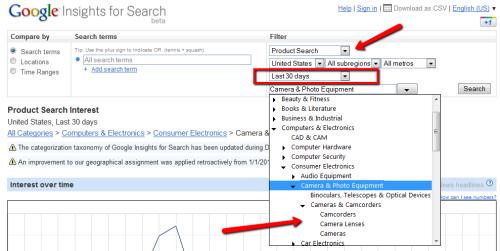
Use the dropdown menus and search for, “Product Search”, select the region you are targeting for, and the last xx days or years of search data. I like to use the 30 day data. In the category section go as “deep” as you can and select the item you are looking for, or just browse among the different categories if you are not certain about what you want. You can also type in directly in the search term box and give it a try..
Google_Insights_Marketing_Search
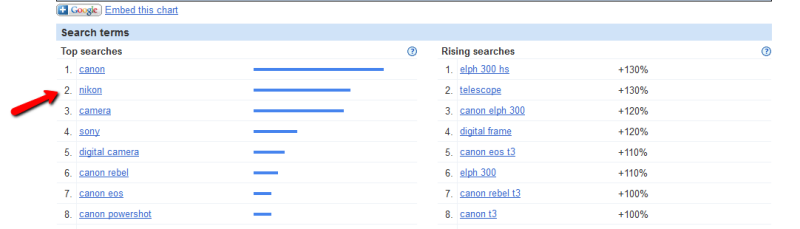
Hit search and you will be presented with the results similar to this one below.
Insights_Product_Search
On the left column you will see the Top search terms and on the right the “rising searches”. For this example, I am going to try Nikon. Canon, although is the most searched, also indicates that it may be very competitive so, I 0ll go for the second one, and so on.. Clicking on “Nikon” returns…
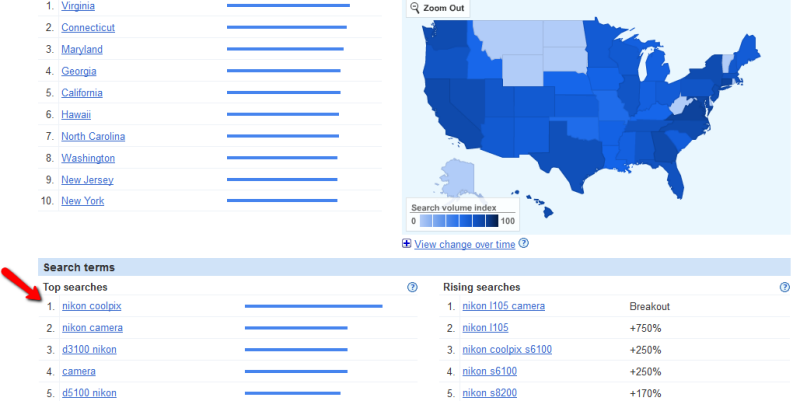
Insights_Product_Search_2
Now that we are given a set of products to choose from. I am going to try Nikon Coolpix and Nikon Coolpix Reviews on use Google’s Keyword Tool… I usually add “reviews” as many people like to do searches this way. So here are the results…
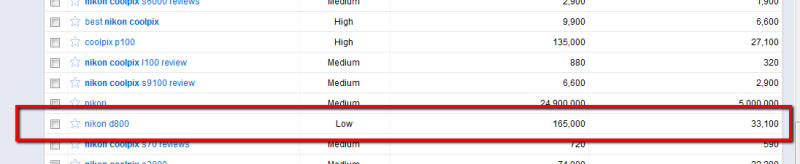
Google_Keyword_Tool_2

From my initial attempt, I found that “Nikon D800” has over 30K local searches. I would normally go for terms that have at least 3.000 local searches and then check competition by using tools such as LongTailPro (aff link) or any other free tool available, like WebSEO analytics (limited but good enough).  So clicking on the Nikon D800, you will see another set of of results and sorting them by searches returns some interesting “keywords” that you can use “around” your new post or edit an older one to fit those related terms. Just remember to check the competition first or you may be targeting “highly competitive” keywords. Note that the “competition “column” on Google’s Keyword Tool is for AdWords advertisers so this is not really an indication of potential competitors. I will be writing a post about how to check competition soon, so stay tuned for that. This is one of the exercises I use to find for products to promote. It takes a bit of effort and lots of research, but then again, who says that making money online was easy? In addition, if some of you may notice (specially Camera fanatics), the reason why the Nikon D800 has very low competition (on AdWords) is because the camera has not yet been officially released. You can use this in your favor an start building buzz around it or use it as a bait for your site or similar products. Be creative..

Next step.. Create Niche Site or Use Top landing Pages

To market the products you identified, there are some ways you can do this. You can create a niche website about a group of products and add individual items as you see fit, or you can use the technique of Using Your Most Viewed Articles For Better Conversions. If you want to see an example of a niche site, here’s a site about Professional Cameras, I launched just last week.
The technique about using your most viewed articles is essentially using Google Analytics or Clicky Website Analytics, to identify your top landing pages and use those pages to market the products you are interested in. It makes sense to do it this way because they are the pages that are generating you lots of traffic and are usually older post, so your loyal readers will not be bothered by it. Just do it wisely :) .
That’s it! I am assuming that you all are familiar with affiliate programs and that you know where to find the “actual” products to promote. Amazon Associates, Google’s Affiliate Network, Commission Junction, are just but a few you can source for products to promote.

quinta-feira, 21 de fevereiro de 2013

Matcha is special.

It’s not steeped. Most teas are either loose-leaf or bagged, and one steeps the tea and tosses the bag or leaves at the end. But matcha is different: it’s stoneground, using big granite wheels, into a fine powder that looks like a hallucinogenic green cocoa. One simply scoops out a half teaspoon or so of the electric-green powder into a bowl or cup, adds some hot (not boiling) water, whisks it up with a traditional bamboo whisk (or, for the more modern among us, a handheld electric milk frothing wand) into a frothy brew, and sips. If whisked well, the fine texture of the matcha crema resembles espresso. Great matcha can rival some of the most coveted wines in the world in terms of flavor complexity and pure enjoyment (and, some would say, price).

Matcha is old. The founder of the Rinzai sect of Zen Buddhism, Eisai Myoan, is credited with bringing matcha (and zen; the two have a longstanding affinity with one another) to Japan from China, where powdered green tea arose during the 8th century, in the late 12th century. Somehow along the way, the use and enjoyment of matcha in China waned, but it was transmitted to Japan, where it developed independently, at first in zen monasteries, and then on to the general public in the form of chanoyu, or the tea ceremony.


Photo credit: Eric Gower

Matcha is healthy. It has more antioxidants by weight than all the popular superfoods – gojiberry, pomegranate, acai berry, wild blueberry, kale, and dark chocolate – combined. One key antioxidant is actually a flavanoid/catechin called EGCG (epigallocatechin gallate), and matcha is crazy full of EGCGs. It has roughly 140x the EGCGs of regular green tea, for the simple reason that matcha is consumed whole. The soluble and insoluble fiber in matcha work in synergy, something that can’t happen in tea that is steeped. It’s this synergistic effect that is responsible for its off-the-charts EGCG count.

There are studies that indicate matcha can be beneficial in treating a variety of cancers and other diseases, as well as assisting digestion and bolstering overall immunity. It’s also packed with an amino acid called L-theanine, which has been widely studied for its potential ability to reduce mental and physical stress and to elevate mood in a synergistic manner with caffeine (at 25 mg per serving, matcha has about a quarter the caffeine of brewed coffee).

A thick, creamy cup in the morning, perhaps with a couple of poached eggs dusted with matcha and sea salt, is my preferred way to start the day. It’s an epicurean AND phytonutrient experience unlike any other.

Editor’s note: Eric Gower is an author and founder of Breakaway Matcha, a specialty tea company focused squarely on sourcing the most exceptional matcha and educating people about how to best enjoy it. He has written four cookbooks, among them The Breakaway Japanese Kitchen and The Breakaway Cook. He blogs regularly here and also writes “The Breakaway Cook” column for the San Francisco Chronicle.